

Best Grunge Bands: The Ultimate 2026 Ranking

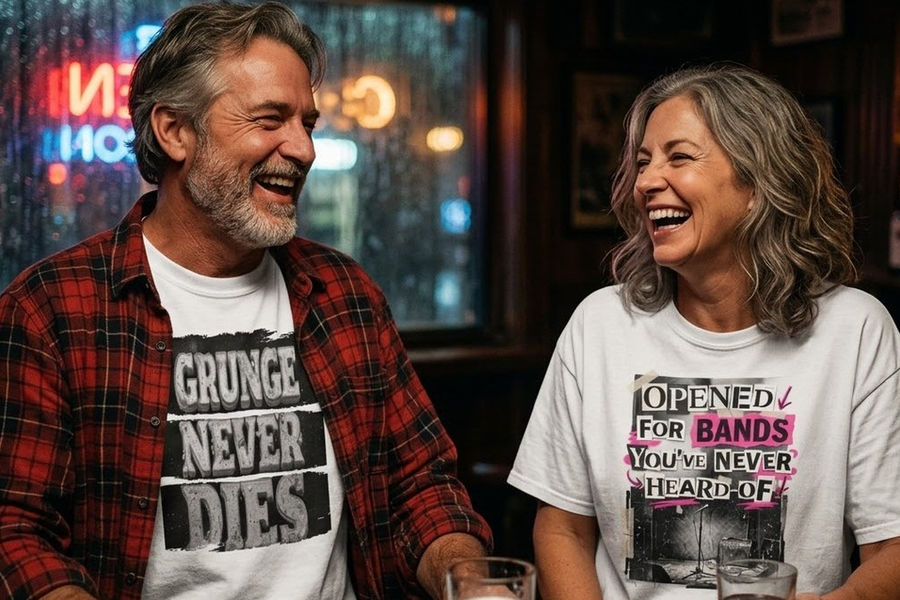
Shown: the Grunge Never Dies and Opened for Bands You've Never Heard Of tees.
Table of Contents
How We Ranked the Best Grunge Bands
The Five Criteria Behind Every Ranking
A Quick Trip Through the Seattle Scene
The Biggest Grunge Bands of All Time, Ranked
1. Nirvana
2. Pearl Jam
3. Soundgarden
4. Alice in Chains
5. Stone Temple Pilots
The Big Four of Grunge and the Genre Boundary Debate
Famous Female Grunge Bands and the Women Who Shaped the Sound
The Best Grunge Albums of All Time
Beyond the Big Names: Grunge Bands Worth Your Ears
Conclusion: Why the Best Grunge Bands Still Matter
Frequently Asked Questions
Last Updated: October 12, 2026
How We Ranked the Best Grunge Bands
Ask ten music fans to name the best grunge bands and you'll get ten different lists, usually delivered with strong opinions and at least one heated defense of a favorite deep cut. This guide from Splendid's Things, where we design vintage-inspired tees for Gen X (yes, including a Grunge Never Dies tee), settles the debate with a transparent method instead of nostalgia alone. We weighed each band on five criteria: influence on later music, commercial success, critical acclaim, lasting appeal, and how well the catalog holds up today.
That last criterion matters more than most rankings admit. A band can sell millions in its moment and still fade from rotation a decade later. The groups that endure tend to share a specific quality: their songs still sound urgent, not dated.
Grunge is the alternative rock movement that grew out of the Seattle scene in the late 1980s and early 1990s, blending punk's raw energy with heavy metal's weight and a distinctly gloomy lyrical outlook. It changed rock radio, fashion, and how record labels signed bands for the rest of the decade.
Below, we'll show you exactly how the ranking works, walk through the Seattle scene's origins, and count down the biggest grunge bands of all time. We also cover the famous female grunge bands and the best grunge albums of all time, so you can build a listening list as you read.
The Five Criteria Behind Every Ranking
Influence: How directly later artists cite the band as a blueprint
Commercial success: Chart performance and album sales during the peak era
Critical acclaim: How critics and historians rate the discography
Lasting appeal: Whether the songs still get played, covered, and streamed
Catalog depth: One great album versus three or four
Every ranking is subjective by nature. Making the criteria visible is what separates a real list from a fan post.
A Quick Trip Through the Seattle Scene
Seattle in the mid-1980s was a rainy, inexpensive city with a tight cluster of clubs, a college radio station willing to play weird records, and a local label, Sub Pop, that turned regional noise into a brand. The scene didn't appear overnight, though. It built in layers, and knowing the order helps you tell the original movement apart from the bands that got labeled grunge later.
The pre-history (1984-1987). The Melvins slowed punk down to a crawl and turned the tempo into a weapon, and their early EPs are the clearest blueprint for what came next. Green River formed in 1984 and released Come on Down in 1985 on Homestead Records, then Dry as a Bone in 1987 on Sub Pop. That 1987 EP is often cited as the first record that sounds unmistakably like grunge. Mudhoney spun out of Green River in 1988 and released "Touch Me I'm Sick" that same year, a single so raw it became the scene's calling card.
The compilation that put the scene on the map (1986). C/Z Records' Deep Six compilation gathered the Melvins, Green River, Soundgarden, Malfunkshun, Skin Yard, and the U-Men on one record. It's the single best snapshot of the pre-fame Seattle sound, and it's the record most histories point to when they want to prove the scene existed before the majors showed up.
The breakthrough (1988-1991). Soundgarden released Ultramega OK on SST Records in 1988, then made their major-label debut with Louder Than Love on A&M in 1989. Mother Love Bone formed from the ashes of Green River and Malfunkshun, signed to a major, and seemed poised to break before frontman Andrew Wood died in 1990. Temple of the Dog was the tribute project that followed. Then Nirvana's Bleach arrived on Sub Pop in 1989, and the major-label signing spree began in earnest.
The explosion (1991-1994). Nirvana's Nevermind landed in September 1991 and sold in numbers nobody in the scene expected. Pearl Jam's Ten arrived a month earlier, Soundgarden's Badmotorfinger in October, and Alice in Chains' Dirt in 1992. By the time Stone Temple Pilots' Core hit in 1992, the industry had descended on the Pacific Northwest looking for the next signing, and the regional scene had become a national genre overnight.
The aftermath (1995 onward). The original movement wound down as the decade wore on, but the label stuck around. Bands like Bush, Silverchair, and Collective Soul got tagged grunge even though they formed outside Seattle and often after the peak. That's why the term is slippery: it describes a specific place and time, but it also became a marketing category that outlived the scene that created it.
Key Takeaway Grunge wasn't invented by the famous bands. It was built by local groups like Mudhoney, Green River, and the Melvins, then exported to the world by the acts that followed. If you want to hear the difference between the original movement and the later label, start with Deep Six and then play Nevermind back to back.
The Biggest Grunge Bands of All Time, Ranked
Here's the countdown, ordered by the five criteria above. Disagreement is welcome, and honestly expected.

Shown: the Ears Ringing Since 1993 tee, for anyone who stood too close to the speakers.
1. Nirvana
No band did more to push grunge into the mainstream. Nirvana paired punk volume with pop instinct, and the frontman's songwriting turned personal frustration into anthems. The catalog is short, only three studio albums, but the influence is enormous. Nearly every alternative band that followed borrowed something from that sound.
2. Pearl Jam
Pearl Jam outlasted almost everyone. The band's debut arrived in 1991 and the group kept touring and releasing records for decades after grunge's commercial peak faded. That longevity, plus a deep catalog of radio staples, gives Pearl Jam a strong case for the top spot depending on how you weight lasting appeal.
3. Soundgarden
The heaviest of the major Seattle acts, Soundgarden fused Black Sabbath-style riffs with odd time signatures and a frontman with one of rock's most powerful voices. Critics loved the ambition. Fans loved the thunder.
4. Alice in Chains
Alice in Chains brought vocal harmonies and a dark, minor-key mood that set the band apart from its peers. The group's sophomore album is widely considered one of the strongest full-length records to come out of the era, and its acoustic release proved the songs worked without the distortion.
5. Stone Temple Pilots
The genre boundary debate starts here. Stone Temple Pilots formed in California, not Seattle, which some purists hold against them. Their hooks were undeniable, though, and their debut and follow-up both sold strongly.
Band | Home Base | Signature Strength | Defining Album |
Nirvana | Seattle | Influence and songwriting | Nevermind |
Pearl Jam | Seattle | Longevity and catalog | Ten |
Soundgarden | Seattle | Riffs and vocal power | Superunknown |
Alice in Chains | Seattle | Harmonies and mood | Dirt |
Stone Temple Pilots | California | Hooks and radio appeal | Core |
The Big Four of Grunge and the Genre Boundary Debate
The Big Four of grunge usually means Nirvana, Pearl Jam, Soundgarden, and Alice in Chains. All four formed in the Seattle area, all four signed to major labels, and all four defined the sound for listeners who discovered the genre through radio and MTV.
So where does that leave Stone Temple Pilots? The band gets included in many lists and excluded from just as many, purely because of geography. Mudhoney (Seattle) and Screaming Trees (from Ellensburg, just over the mountains) sometimes get passed over for the opposite reason: less commercial success. Genre boundaries in grunge are messier than most rankings admit, and that messiness is part of the fun.
Famous Female Grunge Bands and the Women Who Shaped the Sound
Women were central to grunge and the scenes around it, even though the best-known bands were fronted by men. In Seattle, The Gits and 7 Year Bitch anchored the scene with fierce live shows. Hole, fronted by Courtney Love, brought a confrontational, confessional edge that landed on major charts, while L7 and Babes in Toyland brought the same raw energy from Los Angeles and Minneapolis. Up the road in Olympia, Bikini Kill helped launch the riot grrrl movement, which grew up right alongside grunge and shared a lot of its attitude.
And some of the women who shaped the sound did it from inside bands led by men. Kim Gordon of Sonic Youth was a role model for a whole generation of alt-rock women, and she co-produced Hole's 1991 debut, Pretty on the Inside. Lynn Perko powered Sister Double Happiness from behind the drum kit in San Francisco, and D'arcy Wretzky's bass lines and backing vocals were part of what made the Smashing Pumpkins sound so huge. None of them were the frontman in the spotlight, and all of them helped shape the sound of the era.
I was one of those girls, too: a grunge singer in the 90s, with a band of my own and the flannel to prove it. (Yes, I own the Opened for Bands You've Never Heard Of tee. Of course I do.)
Leaving these acts out of a grunge conversation isn't just incomplete. It misses where a lot of the genre's attitude actually came from.

Your humble correspondent, growling it up in the 90s inner-loop Houston, Texas scene.
Pro Tip If you only know grunge from the Big Four, start with Live Through This by Hole and Bricks Are Heavy by L7. Both hold up as well as anything the major acts released.
The Best Grunge Albums of All Time
Any best grunge albums of all time list has to start with Nevermind, the record that turned a regional sound into a global one. From there, the consensus picks stack up quickly:
Nevermind (Nirvana): the commercial breakthrough
Ten (Pearl Jam): arena-sized songwriting with raw edges
Superunknown (Soundgarden): heavy, ambitious, and a massive commercial hit
Dirt (Alice in Chains): the darkest, most cohesive front-to-back listen
Core (Stone Temple Pilots): the hookiest debut of the era
Above (Mad Season): a Seattle side project worth seeking out
Sweet Oblivion (Screaming Trees): the scene's most underrated full-length
Start with those seven and you have the genre covered from every angle: pop, metal, punk, and everything in between.
Beyond the Big Names: Grunge Bands Worth Your Ears
The famous names are only part of the story. Mudhoney signed to Sub Pop before any of the Big Four broke through and stayed stubbornly underground, which is exactly why purists love them. Screaming Trees never reached the same commercial heights but released a run of strong records. Temple of the Dog was a one-album tribute project that featured members of Soundgarden and Pearl Jam, and it remains a fan favorite. Mother Love Bone came first and pointed directly at what was coming.
Outside Seattle, Bush and Silverchair carried the sound into the late 1990s for audiences who discovered grunge after the peak. Foo Fighters formed from the ashes of Nirvana and turned into one of rock's biggest acts, though most fans file them under post-grunge rather than the original movement.
Watch Out Don't judge these bands by chart position alone. Several of the most influential acts in the Seattle scene never had a top-ten single, and that's precisely why later musicians studied them.
Conclusion: Why the Best Grunge Bands Still Matter
The best grunge bands still matter because the sound never really left. It shows up in modern rock, in fashion, and in the flannel-and-band-tee uniform that never went out of style. Splendid's Things knows that look well. Our Grunge Never Dies tee was made for exactly that kind of nostalgic, slightly sarcastic self-expression, and our music tees, like Ears Ringing Since 1993 and Opened for Bands You've Never Heard Of, are for anyone who spent the 90s too close to the speakers. Adult tees are garment-dyed Comfort Colors cotton in sizes S–4X. Put one on, turn the volume up, and let the debate run.
Frequently Asked Questions
What aesthetic is grunge?
Grunge style is thrift-store flannel, ripped jeans, oversized cardigans, and a deliberate lack of polish. It grew out of the Seattle scene in the late 1980s as a rejection of hair metal's glam. The look matched the sound: raw, fuzzy guitars, introspective lyrics, and a whatever attitude. Think layers, muted colors, and clothes that look like you grabbed them off the floor. If you lived through it the first time, you already know the vibe.
Who are the biggest grunge bands?
The biggest grunge bands are Nirvana, Pearl Jam, Soundgarden, and Alice in Chains, often called the Big Four. Stone Temple Pilots, Mudhoney, Screaming Trees, and Temple of the Dog also rank high among fans. Nirvana and Pearl Jam drove the genre into the mainstream in the early 1990s, while Soundgarden and Alice in Chains brought heavier, darker edges. Each left a legacy that still shapes alternative rock today.
Who is the godfather of grunge?
Neil Young is widely called the godfather of grunge. His distorted guitar work and raw songwriting on albums like Rust Never Sleeps influenced the Seattle bands directly. Pearl Jam backed him on Mirror Ball, and his refusal to fit neatly into classic rock made him a natural fit. Some fans also point to Mudhoney or the Melvins as the true godfathers of the Seattle scene itself.
What are some famous female grunge bands?
Famous female grunge bands include L7, Babes in Toyland, Hole, and 7 Year Bitch. These bands came from the same DIY punk and alternative rock world as the Seattle scene and brought a ferocious, unapologetic energy. Hole's Live Through This is often cited as one of the best grunge albums of all time. Their influence on later women in rock is hard to overstate.


Comments